


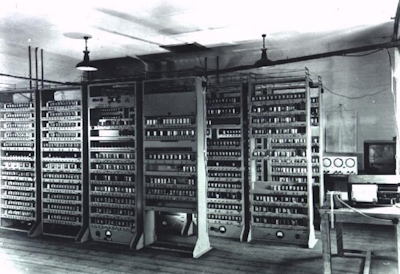
As a species, we are fascinated by origins – as Maya Angelou, the American poet and civil rights activist is attributed as saying, “You can’t really know where you are going until you know where you have been”. Of course, much of archaeology is concerned one way or another with narratives around origins, be they people or pots, but digital archaeology seems much less interested in its own origins. As part of a recent presentation on the digitalisation of archaeology to the Norwegian Institute at Athens, I took the opportunity to look back at what I loosely called the ‘prehistory’ of digital archaeology as the basis for looking forward. What was digital archaeology like at its beginnings, at least seventy years or more ago? It turns out to be a surprisingly difficult question to answer: other than some important work by Paola Moscati and Francois Djindjian, for example, digital archaeologists are remarkably bad at thinking about our past.
The relative lack of attention to digital archaeology’s past could be seen to be a natural consequence of the ever faster developing digital environment, but it may also be a reflection of the significance that has been given to George Cowgill’s 1967(a,b) review of computer applications in archaeology. According to Cowgill, the earliest archaeological computer application he knew of was by Jean-Claude Gardin and Peter Ihm in France in 1958-1959 (1967a, 17). He also identified James Deetz as responsible for the earliest use in the USA in 1960. Cowgill’s statement has served as the basis for most subsequent reviews (e.g., Wilcock 1999, 35; Watrall 2016, 346; Huggett 2018) and has consequently become something of an origin myth. Not surprisingly, dig a little deeper, and it becomes clear that this is not the whole story.