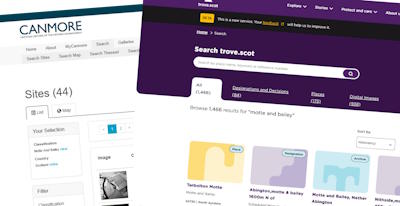
Search succession – Canmore (left) and Trove (right)
We seem to be living in interesting times here in the UK, at least as far as changes to major archaeological digital infrastructures providing access to national historic environment records and associated archive data are concerned. The Archaeology Data Service has radically updated ArchSearch with a new interface; in Scotland, the well-established Canmore has been replaced by the new Trove website; in England, the launch of a new Heritage Gateway is due by the end of the year. Novelty can be very unsettling and risky, especially when it involves the replacement of a long-established, familiar, and reliable, digital system. And of course, unwanted novelty can give rise to resistance and complaint. So how is that working out?
Detail from Woman at a Window, by Casper David Friedrich (1822)
We understand knowledge construction to be social and combinatorial: we build on the knowledge of others, we create knowledge from data collected by ourselves and others, and so on. Although we pay a lot of attention to the processes behind the collection, recording, and archiving of our data, and are concerned about ensuring its findability, accessibility, interoperability, and reusability into the future, we pay much less attention to the technological mediation between ourselves and those same data. How do the search interfaces which we customarily employ in our archaeological data portals influence our use of them, and consequently affect the knowledge we create through them? How do they both enable and constrain us? And what are the implications for future interface designs?
As if to underline the lack of attention to interfaces, it’s often difficult to trace their history and development. It’s not something that infrastructure providers tend to be particularly interested in, and the Internet Archive’s Wayback Machine doesn’t capture interfaces which use dynamically scripted pages, which writes off the visual history of the first ten years or more of development of the Archaeology Data Service’s ArchSearch interface, for example. The focus is, perhaps inevitably, on maintaining the interfaces we do have and looking forward to developing the next ones, but with relatively little sense of their history. Interfaces are all too often treated as transparent, transient – almost disposable – windows on the data they provide access to.