A Prehistory of Digital Archaeology
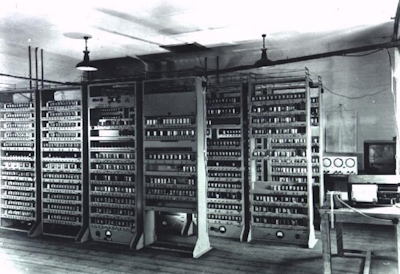
As a species, we are fascinated by origins – as Maya Angelou, the American poet and civil rights activist is attributed as saying, “You can’t really know where you are going until you know where you have been”. Of course, much of archaeology is concerned one way or another with narratives around origins, be they people or pots, but digital archaeology seems much less interested in its own origins. As part of a recent presentation on the digitalisation of archaeology to the Norwegian Institute at Athens, I took the opportunity to look back at what I loosely called the ‘prehistory’ of digital archaeology as the basis for looking forward. What was digital archaeology like at its beginnings, at least seventy years or more ago? It turns out to be a surprisingly difficult question to answer: other than some important work by Paola Moscati and Francois Djindjian, for example, digital archaeologists are remarkably bad at thinking about our past.
The relative lack of attention to digital archaeology’s past could be seen to be a natural consequence of the ever faster developing digital environment, but it may also be a reflection of the significance that has been given to George Cowgill’s 1967(a,b) review of computer applications in archaeology. According to Cowgill, the earliest archaeological computer application he knew of was by Jean-Claude Gardin and Peter Ihm in France in 1958-1959 (1967a, 17). He also identified James Deetz as responsible for the earliest use in the USA in 1960. Cowgill’s statement has served as the basis for most subsequent reviews (e.g., Wilcock 1999, 35; Watrall 2016, 346; Huggett 2018) and has consequently become something of an origin myth. Not surprisingly, dig a little deeper, and it becomes clear that this is not the whole story.
There are perhaps two reasons why the earliest beginnings of digital archaeology are so hard to pin down accurately. First is that, as Cowgill recognised, machine-sorted punch card systems had been used by archaeologists much earlier, but these are not given prominence in the digital story. Secondly, much of the work carried out, whether using machine-sorted or early electronic systems, was either not published, or else the fact these devices were used was not considered worthy of specific reference in the publications. Digital archaeology is not unique in this regard: digital humanities has similar problems in pinning down its origins (e.g., McCarty 2003, 1224ff). For example, it is widely accepted that Roberto Busa pioneered humanities computing through his famous meeting with the founder of IBM, Thomas J. Watson Sr, in November 1949 and his subsequent work in collaboration with IBM on a punched card-based concordance. However, whether he was the earliest is open to question, including by Busa himself (Busa 1980, 84; see also Rockwell 2007, for example). Indeed, the use of tabulating machine punched cards in historical work can be traced back at least to the early 1930s with William Murray’s use of punched cards (Swierenga 1970, 2; Murray 1933). Of course, even then, such machines were not new: Herman Hollerith had invented the electronic tabulating machine which used punch cards to record data in the late 1880s.
While it is unlikely that digital archaeology can ever push its origins back into the 1930s, nevertheless it seems improbable that archaeologists in the late 1940s and early 1950s, contemporary with Roberto Busa, were unaware of the potential value of mechanical methods of data processing, although evidence is sparse with few direct references. For example, Bobowski (2019, 13) suggests that George Brainerd (1951) and William Robinson (1951) were the early pioneers in archaeology, but neither of their publications that year make any reference to machines and simply refer to ‘computation’ in the context of a statistical technique. However, in 1953 Albert Spaulding referred to the potential for mechanical and electronic methods of data processing in archaeology, although there’s no direct indication that he was himself using them at that time (Spaulding 1953, 312). The earliest direct evidence for their use is in 1955, when Jean-Claude Gardin and Jean Deshayes used mechanical machines and punch cards to sort Bronze Age metal tools (Gardin 1958, 335; Gardin 1959; Moscati 2013, 8-9). Initially a hand-operated mechanical Dequeker was used but the limited capacity of the punch cards and handling restrictions meant that Gardin moved to a non-mechanical Sélecto system which simply superimposed cards in a reading frame (Gardin 1959, 15-17; see also Moscati 2013, 15-16).
Although Gowgill identifies Gardin and Ihm as the earliest pioneers of electronic processing in 1958-9 to automatically classify Bronze Age axes (and curiously, Gardin (1959) makes no mention of it in his brochure), Irwin Scollar suggests that Robert Cook and John Belshe had earlier used an EDSAC computer in 1957 to process magnetic dating results (Scollar 1982, 189). Scollar himself used a Standard Electric Lorenz ER 56 to filter resistivity data in 1959 (Scollar 1982, 190). James Deetz was using an IBM 704 in his PhD research on Arikara ceramics, and as this was awarded in 1960 this means he was working with computers at much the same time as Gardin, Ihm, and Scollar (Deetz 1965, 49), and so somewhat earlier than Cowgill claimed.
The ability to tap into expensive and scarce research facilities was clearly key: Cook and Belshe had access to the EDSAC at the University of Cambridge Mathematical Laboratory, Scollar used facilities at the University of Bonn, Gardin was primarily using the resources of EURATOM (the European Atomic Energy Community) while Deetz had access to the MIT Computation Laboratory. In short, equipment was hard to use and hard to get hold of. What also seems quite clear is that early on there was little awareness of what others were up to (at least as shown in publications): the computer aspects of the work largely seem to be undertaken without reference to others, which contributes to an impression of isolation. It is only as we move into the mid-1960s, with the appearance of the Newsletter of Computer Archaeology, for instance, that we see the exchange of ideas and methods starting to circulate with some regularity.
So, these are the beginnings of digital archaeology, although given the nature of the evidence, it seems highly likely to change as new information is uncovered. And of course, each of us will have our own origin story to add: in my case, my first archaeological computer program and data were hand-written on data sheets which the data preparation ladies translated into punch cards and which I then passed to the computer technicians to feed to an ICL 2966 in 1984.
But it is one thing to identify the origins of computer use in archaeology – more challenging still is to place them in their proper contemporary context, not just in terms of practices but also ideas. What were the perceptions of computers at the time? For instance, McCarty (2013, 6-7) writes of the anxieties and fears surrounding these devices in the 1950s, associated as they were with industrialisation, the Cold War, bureaucratisation, and quantification, as well as concerns over the effects of their disciplinary use, all of which affected – and potentially discouraged – the adoption of computers at the time. It’s important to assess these early applications in their own terms rather than bring to bear our present-day attitudes, otherwise we risk a form of ‘presentism’ (e.g. John 2023), where we interpret past phenomena in terms of current knowledge and beliefs which can lead to a distorted understanding of the complexities of the past.
[Portions of this post are based around my presentation to the NIA workshop on Data and Technology Politics in Archaeology in December 2025. I should like to thank the Norwegian Institute at Athens for their invitation, in particular Markos Katsianis and Paschalis Zafeiriadis, as well as the other members of the organising board: Nicoló Dell’Unto, Björn Nilsson, and Søren Handberg]
References
Bobowski, B. (2019) ‘Past Perfect metod cyfrowych w archeologii (1951–1999) [The history of digital methods in archaeology (1951-1999)]’, Echa Przeszłości, 20(1), pp. 13–52. https://doi.org/10.31648/ep.4827.
Brainerd, G.W. (1951) ‘The Place of Chronological Ordering in Archaeological Analysis’, American Antiquity, 16(4), pp. 301–313. https://doi.org/10.2307/276979.
Busa, R. (1980) ‘The Annals of Humanities Computing: The Index Thomisticus’, Computers and the Humanities, 14(2), pp. 83–90. https://www.jstor.org/stable/30207304
Cowgill, G.L. (1967a) ‘Computer Applications in Archaeology’, Computers and the Humanities, 2 (1) (September), pp. 17–23. https://doi.org/10.1007/BF02402460.
Cowgill, G.L. (1967b) ‘Computer Applications in Archaeology’, in Proceedings of the November 14-16, 1967, Fall Joint Computer Conference (AFIPS ’67 (Fall)), pp. 331–7. New York, NY: ACM Press. https://doi.org/10.1145/1465611.1465654.
Deetz, J. (1965) The Dynamics of Stylistic Change in Arikara Ceramics. Urbana: University of Illinois Press. https://archive.org/details/dynamicsofstylis0000deet.
Gardin, J.-C. (1958) ‘Four Codes for the Description of Artifacts: An Essay in Archeological Technique and Theory’, American Anthropologist, 60(2), pp. 335–357. http://www.jstor.org/stable/665165
Gardin, J.-C. (1959) Centre d’Analyse Documentaire pour l’Archéologie. Paris, France: Centre National de la Recherche Scientifique. Available at: https://archaeologicalcomputing.lincei.it/node/30.
Huggett, J. (2018) ‘Computer Applications in Archaeology’, in S.L. López Varela (ed.) The Encyclopedia of Archaeological Sciences. Hoboken, NJ, USA: John Wiley & Sons, Inc., pp. 1–5. https://doi.org/10.1002/9781119188230.saseas0108.
John, R.R. (2023) ‘Debating New Media: Rewriting Communications History’, Technology and Culture, 64(2), pp. 308–358. https://doi.org/10.1353/tech.2023.0055
McCarty, W. (2003) ‘Humanities Computing’, in M. Drake (ed) Encyclopedia of Library and Information Science. New York, NY: Marcel Dekker Inc., pp. 1224-1235.
McCarty, W. (2013) ‘What does Turing have to do with Busa?’, in F. Mambrini, M. Passarotti, and C. Sporleder (eds) Proceedings of the Third Workshop on Annotation of Corpora for Research in the Humanities (ACRH-3), Sofia, Bulgaria: Institute of Information and Communication Technologies Bulgarian Academy of Sciences, pp. 1–14.
Moscati, P. (2013) ‘Jean-Claude Gardin (Parigi 1925-2013). Dalla meccanografia all’informatica archeologica’, Archeologia e Calcolatori, 24, pp. 7–24. https://doi.org/10.19282/ac.24.2013.01
Robinson, W.S. (1951) ‘A Method for Chronologically Ordering Archaeological Deposits’, American Antiquity, 16(4), pp. 293–301. https://doi.org/10.2307/276978.
Rockwell, G. (2007) ‘An alternate beginning to humanities computing’ Theoreti.ca, 2 May. Available at: https://theoreti.ca/?p=1608 (Accessed: 1 February 2026).
Scollar, I. (1982) ‘Thirty Years of Computer Archaeology and the Future, or Looking Backwards and Forwards at the Same Time While Trying Not to Twist One’s Neck’, in S. Laflin (ed) Computer Applications in Archaeology 1982 pp. 189–98. University of Birmingham: Centre for Computing and Computer Science. https://proceedings.caaconference.org/paper/21_scollar_caa_1982/.
Spaulding, A.C. (1953) ‘Statistical Techniques for the Discovery of Artifact Types’, American Antiquity, 18(4), pp. 305–313. https://doi.org/10.2307/277099.
Swierenga, R.P. (1970) ‘Clio and Computers: A Survey of Computerized Research in History’, Computers and the Humanities, 5(1), pp. 1–21. https://www.jstor.org/stable/30204000
Watrall, E. (2016) ‘Archaeology, the Digital Humanities, and the “Big Tent”’, in M.K. Gold and L.F. Klein (eds) Debates in the Digital Humanities 2016. Minneapolis: University of Minnesota Press, pp. 345–358. https://doi.org/10.5749/j.ctt1cn6thb.31.
Wilcock, J.D. (1999) ‘Getting the Best Fit? 25 Years of Statistical Techniques in Archaeology’, in Archaeology in the Age of the Internet. Computer Applications and Quantitative Methods in Archaeology: Proceedings of the 25th Anniversary Conference, University of Birmingham, April 1997. Oxford, UK: Archaeopress (British Archaeological Reports International Series, 750), pp. 35–52. https://proceedings.caaconference.org/paper/07_wilcock_caa_1997/.