


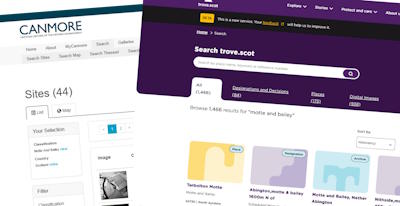
We seem to be living in interesting times here in the UK, at least as far as changes to major archaeological digital infrastructures providing access to national historic environment records and associated archive data are concerned. The Archaeology Data Service has radically updated ArchSearch with a new interface; in Scotland, the well-established Canmore has been replaced by the new Trove website; in England, the launch of a new Heritage Gateway is due by the end of the year. Novelty can be very unsettling and risky, especially when it involves the replacement of a long-established, familiar, and reliable, digital system. And of course, unwanted novelty can give rise to resistance and complaint. So how is that working out?
The venerable English Heritage Gateway, managed by Historic England, is some 16 years old which makes it positively prehistoric in internet terms and, as Turton (2024) notes, it currently fails accessibility and other essential standards. An entirely new system, harvesting local and regional datasets into a central repository for access and query has been under development and the new beta version Heritage Gateway was due to be launched in late 2025. As of writing it has not yet been released but according to Exegesis the new API was working successfully against ten HERs earlier this year. Of course, the distance between a working API and a public facing user interface is considerable so it may be a while before a beta version becomes available.
The most recent Welsh update to its HER system was rather earlier than the others described here. In Wales, Coflein was originally developed under the SWISH (Shared Web Information Services for Heritage) partnership established in 2003 between the Royal Commissions on the Ancient and Historical Monuments of Wales and Scotland (RCAHMW and RCAHMS) which meant that for years Canmore and Coflein shared a common design and development infrastructure for their respective site inventories and archives. With the demise of SWISH, partly a consequence of the merger of the RCAHMS with Historic Scotland and the creation of Historic Environment Scotland, a new interface to Coflein was introduced in 2021 built on existing modular solutions (Thomas and Pert 2020). Unsurprisingly, there were initial teething problems – for instance, reports of incompatibilities with older handheld devices and some issues redirecting links from existing links to records but on the whole, the transition seems to have been relatively smooth.
Last month, the Archaeology Data Service launched its new ADS Data Catalogue, formerly known as ArchSearch. ArchSearch was first launched in 1998 with an update in 2002 before ArchSearch III was launched in 2010 with the familiar facetted classification browser and geospatial search tool: this last version lasted until 2025. Like Heritage Gateway, it’s notable how long this interface had been in use, but unlike Heritage Gateway, remarkable how well it has held up over the years. The ArchSearch replacement was due to launch earlier this year, but was held back until October, partly to ensure reliability and to produce training and support materials, but also likely affected by the ADS involvement in the creation of the new Heritage Science Data Service. The new Data Catalogue is based on the same system as developed by the ADS for the ARIADNE portal which clearly provides a significant headstart and reassurance as to reliability, although some elements of the old ArchSearch such as downloading record sets have not yet been released. As far as can be told, the transition seems to have gone smoothly with few problems evident – at least, it’s very quiet online in comparison with the next case!
The replacement for Canmore, Trove, is a rather different story, recently described by Connolly and Kdolska (2025) as “an unmitigated disaster”. It was launched in February 2025 by Historic Environment Scotland (HES) and the two systems ran in parallel until 24th June 2025 when Canmore was switched off. A host of problems with Trove were identified at an early stage (e.g. see this BlueSky thread by @tagishsimon who argued in May 2025 that the switch to Trove was premature). Many of the issues remain unresolved – for instance, the ability to search against a wordlist has been lost, as has the ability to search by ID number, and the map interface has been removed. Search results cannot be further narrowed down or refined. The roadmap for Trove (ironically, the link to it on the main page is broken) shows a list of “things we’re working on now” which rather underlines some of what has been lost by in switch from Canmore. “Things we’re exploring” includes some fairly fundamental issues around coordinate data, site extents and so on, while “Things we’ve recently done” seems to include various feature which seem less than critical at this point (ability to donate to HES, for instance). Underlining the impression of a premature switch-off, confirmation of the shutdown of Canmore included the information that not all records from Canmore and Scran had been migrated at that point. Although “most content from Canmore” had been transferred, of Scran’s collection of over 360,000 heritage and cultural digital resources “There are around 200,000 records that we anticipate will be added to trove.scot by March 2026”. Further sites are being removed by the end of the year (e.g., Historic Land Use and Properties in Care), while others such as Pastmap (interactive mapping for the historic environment – all the more crucial given the absence of mapping in Trove at present) are on borrowed time. The account by Connolly and Kdolska (2025) suggests considerable confusion and disarray, both inside and outside HES, surrounding what had been a flagship heritage system and major problems for any individual or organisation relying on the functionality of Trove after the shutdown of Canmore. Hamilton (2025) describes Canmore and allied systems as
part of the early glory years of digital humanities where the seriousness of purpose and democratic outlook of twentieth century Scottish scholarship took the new online means of transmission and showed the world what might be achieved with them
which only serves to make the current situation worse.
The contrast between these four examples is quite marked, although the lack of overall transparency in most cases makes it difficult to trace the history of the changes made and to understand what any underlying issues might be beyond pure speculation. But what this does demonstrate is the scale of our reliance on these infrastructural systems and the problems that arise when they either don’t perform as required or expected, or when changes are made that negatively impact on their users’ experiences. I’ve written before about how interfaces both enable and constrain access to data, providing certain perspectives over others, and it’s when these are re-released in new forms or simply break down that these issues become most apparent and we are faced with the fragility of otherwise fundamental resources. In the absence of information about user-needs studies, design criteria, development plans, and so on behind these big infrastructural redevelopments, it’s unfortunately impossible to see what choices have been made and why, what compromises have been struck, and what opportunities may have been missed. Of course, the measure of a successful switch to a new system is in how little friction the transition causes, and in the light of the experiences described here it’ll be interesting to see how the new English Heritage Gateway lands.
Declaration of interest: I was a RCAHMS Commissioner until its merger with Historic Scotland and the creation of Historic Environment Scotland, and in that capacity was a member of the SWISH steering group. I am also currently a vice-chair of the ADS management committee.
References
Connolly, D. and Kdolska, H. (2025) Deep Concerns for Historic Environment Scotland. British Archaeology Jobs and Resources: News (31st October 2025). https://web.archive.org/web/20251102165607/https://www.bajr.org/deep-concerns-for-historic-environment-scotland/
Hamilton, J. (2025) Celebrating Canmore (blogpost) https://web.archive.org/web/20250529180622/https://www.jameshamilton.co.uk/uncategorized/2025/05/25/celebrating-canmore.html
Thomas, D. and Pert, T. (2020) Delivering the Archive – A Modular Approach. Digital Past 2020: New Technologies in Heritage, Interpretation and Outreach (Aberystwyth) https://rcahmw.gov.uk/wp-content/uploads/2019/11/3.-Delivering-the-Archive-a-modular-approach-Eng.pdf
Turton, P. (2024) New Heritage Gateway Overview (version 1) Github. https://github.com/HistoricEngland/H.API/blob/master/NewHeritageGatewayOverview.md